
Before Ghostbusters, There Was Houdini
Some images in this post were sourced from Canva and used under license.
Before ghost-hunting TV shows and viral psychic TikToks, there was Harry Houdini, a Hungarian-American escape artist. Houdini was best known for surviving impossible stunts and wriggling out of handcuffs while suspended upside-down over city streets. However, what many people don’t realize is that Houdini was also one of the first, and fiercest, debunkers of paranormal frauds.

The Houdini Rule
The Houdini Rule: Just because something is unexplained does not mean it’s paranormal, supernatural, extraterrestrial, or conspiratorial.
Houdini didn’t hate mystery; he thrived on it. What he despised was manipulation, especially when it preyed on the grieving.
The Rise of Spiritualism (And the Fakes Who Cashed In)
In the 19th and early 20th centuries, spiritualism swept through the U.S. and Europe like a séance-fueled wildfire. After the devastating losses from the Civil War and World War I, people were desperate to reconnect with their lost loved ones. Mediums emerged, promising just that—for a fee, of course.
There were table-tippings, ghostly sounds, automatic writing, mysterious ectoplasm (super gross), and spirit photos featuring spectral relatives “photobombing” from the beyond.

From Believer to Debunker
After the death of his beloved mother, Houdini wanted desperately to believe in the afterlife. However, séance after séance proved to lack reality. Who better to spot sleight of hand than a literal master of it?
Using his background in stage magic, Houdini exposed how mediums utilized trap doors, hidden wires, ventriloquism, and clever misdirection. He wasn’t aiming to destroy belief; he wanted to stop exploitation.
Applying the Houdini Rule (Before It Had a Name)
“A claim made without evidence can be dismissed without evidence.”
You might recognize the quote: “A claim made without evidence can be dismissed without evidence.” While often credited to Carl Sagan, Houdini lived this principle first. He even joined the Scientific American Committee and helped offer a $5,000 reward to anyone who could prove their psychic abilities. Spoiler alert: no one ever collected.

Once Houdini became too famous to blend in, he attended séances in disguise, exposing famous frauds like:
- Joaquín Argamasilla, a Spanish man who claimed he could see through metal
- Mina “Margery” Crandon, Boston’s sweetheart medium
- Nino Pecoraro, who faked spirit messages during séances
He documented his adventures in his 1924 book, “A Magician Among the Spirits”.
Houdini vs. Sir Arthur Conan Doyle: When Magic Met Mystery
This is where things get awkward.
Houdini had a complicated friendship with Sir Arthur Conan Doyle, the creator of Sherlock Holmes. You’d think the fiction writer would be the skeptic and the magician the dreamer. Nope.
Doyle was deeply invested in spiritualism and believed Houdini possessed actual supernatural powers—he even thought Houdini was channeling spirits to perform his tricks. Houdini repeatedly attempted to explain that they were merely illusions. Their friendship eventually crumbled under the weight of their opposing beliefs.
Houdini’s Secret Code and Final Test
Before his death, Houdini made a pact with his wife, Bess: “If there’s an afterlife, I’ll find a way to come back and prove it.”
They agreed on a secret code: “Rosabelle, believe” (a nod to their favorite song). After his death on October 31, 1926, Bess held annual séances every Halloween for ten years. No convincing contact was ever made.
To this day, Houdini séances are held every Halloween by fans and skeptics alike—but so far, the master of escape hasn’t returned from the afterlife.
Why Houdini Still Matters
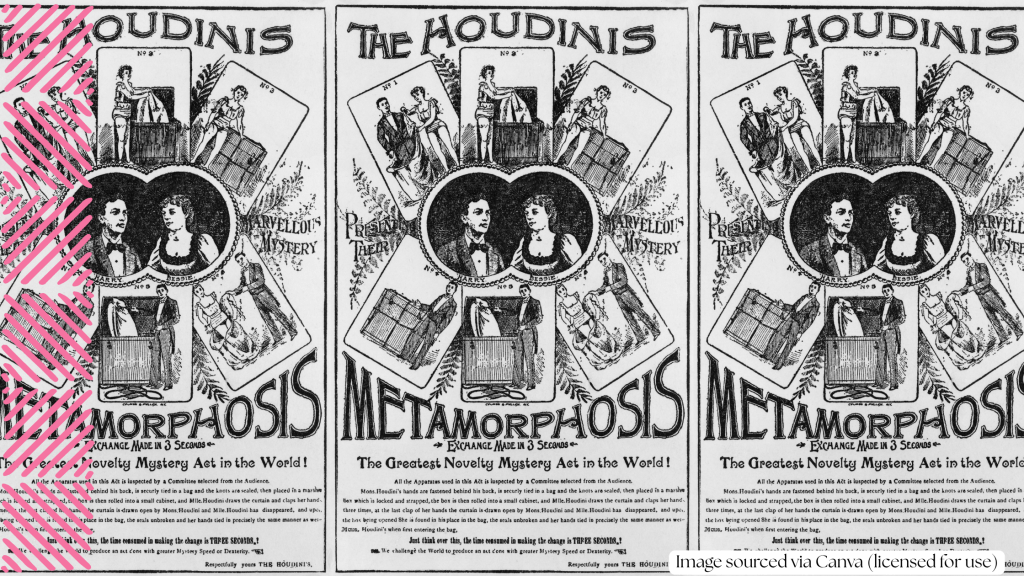
In the age of Instagram witches and viral spirit box videos, Houdini’s legacy continues to be relevant. He reminds us that:
- Not everything unexplained is unexplainable.
- Grief makes us vulnerable—and that makes critical thinking more important than ever.
- Magic is about wonder, not deception.
Houdini paved the way for modern skeptics like James Randi and Penn & Teller, demonstrating how wonder and logic can coexist.
Magic vs. Mystery
Houdini didn’t reject mystery—he lived for it. However, he demanded honesty in the face of grief and spectacle. His mission wasn’t to destroy belief, but to protect it from fraud.
He served as the president of the Society of American Magicians from 1917 until his death. Additionally, he published his own “Conjurers’ Monthly Magazine”, partially to amplify his voice and partially to roast his enemies. (The man loved a dramatic flourish.)
Quick Facts You Didn’t Know You Needed
- Born Erik Weisz in Hungary in 1874.
- Became known as Harry “Handcuff” Houdini on the vaudeville circuit.
- Took the name “Houdini” after French magician Jean-Eugène Robert-Houdin.
- Famous escapes include the Milk Can Escape, Chinese Water Torture Cell, Suspended Straightjacket, and Buried Alive stunt.
- His last performance was on October 24, 1926, at the Garrick Theater in Detroit.
- He likely died from appendicitis complicated by repetitive trauma.
If Houdini taught us anything, it’s this: Mystery is magical, but truth is powerful.
Stick around for more stories that honor both. Subscribe, share, and challenge the unbelievable
 Haunted by History and Institutional Memory
Leave a comment